Why Knee Pain Becomes More Common After 50: The knee is the largest joint in the body and one of the most mechanically complex. By the time we reach our 50s, several age-related changes converge to make it more vulnerable:
- Cartilage thinning: Articular cartilage, the cushioning tissue at the ends of bones, loses water content and elasticity over time, reducing its ability to absorb shock during movement.
- Muscle loss (sarcopenia): After age 30, adults lose about 3–5% of muscle mass per decade. The quadriceps, in particular, are critical knee stabilizers. Weaker quads mean more stress transferred directly to the joint.
- Ligament stiffness: Connective tissue becomes less pliable, reducing the joint’s ability to respond dynamically to load changes.
- Weight changes: Each additional pound of body weight adds roughly 4 pounds of force across the knee during walking. Over time, even modest weight gain significantly increases cumulative joint stress.
- Reduced synovial fluid production: This natural joint lubricant decreases with age, contributing to the characteristic morning stiffness many people over 50 experience.
Understanding these mechanisms matters because it explains why the best exercises for knee pain over 50 target muscle strength and flexibility, not just symptom relief. You’re not just managing pain; you’re addressing the underlying mechanical causes.
Practical Insight
Movement is medicine for arthritic knees. Synovial fluid, which nourishes cartilage and reduces friction, is circulated through joint compression during movement. Extended periods of rest can actually worsen stiffness and accelerate cartilage deterioration.
Strengthening Exercises: The Foundation of Knee Pain Relief
The strongest evidence base for knee pain management in adults over 50 centers on progressive resistance exercises, particularly those targeting the muscles surrounding the knee. Here are the most well-supported options, organized from lower to higher intensity:
1. Straight Leg Raises
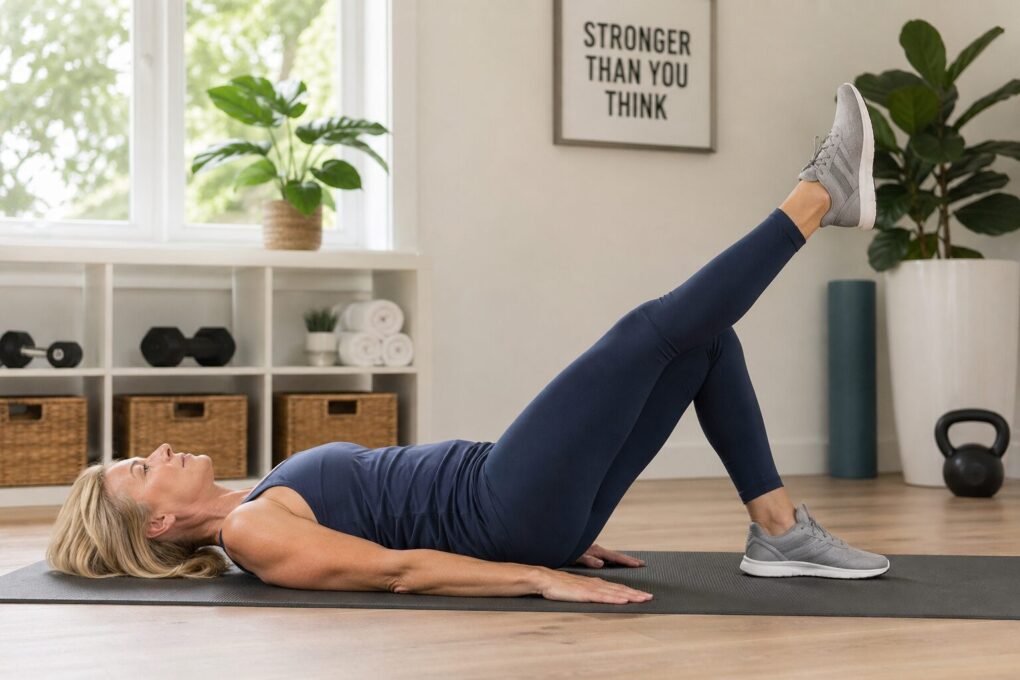
Straight Leg Raises
BeginnerQuadricepsNo equipment
Lie flat on your back. Bend one knee, keeping the foot flat on the floor. Slowly raise the other leg, keeping it straight, to about 45 degrees, hold for 3 seconds, then lower. Repeat 10–15 times per leg, 2–3 sets. This isolates the quadriceps without placing any compressive load on the knee joint itself.
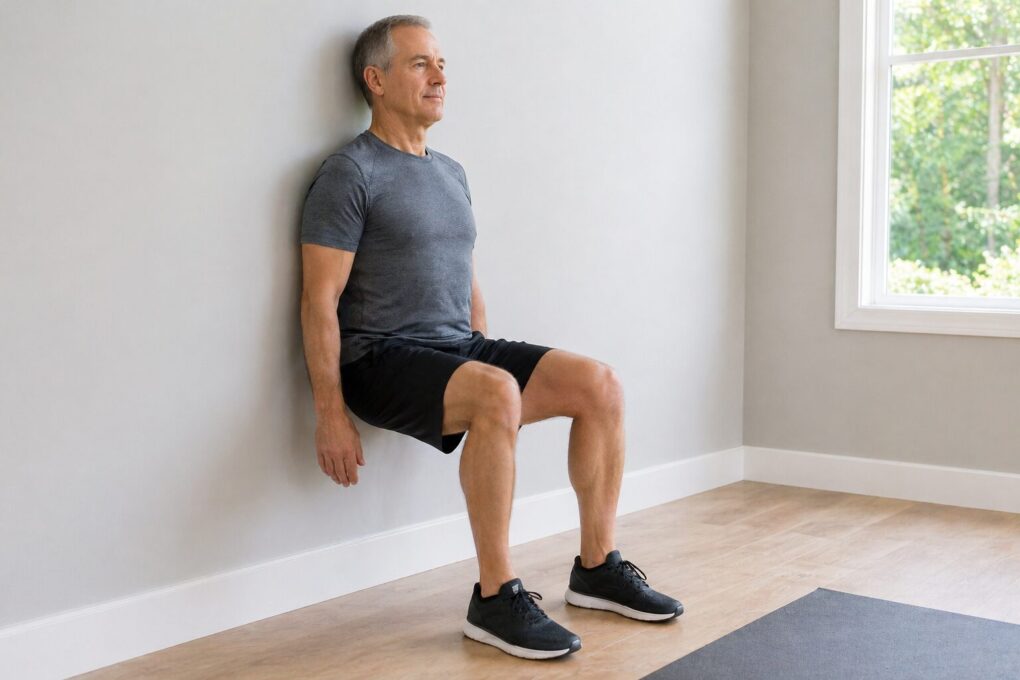
2. Wall Sits (Partial)
Partial Wall Sits
IntermediateQuadricepsGlutes
Stand with your back against a wall, feet shoulder-width apart. Slide down to a 20–30 degree bend (not a full 90-degree squat) and hold for 10–30 seconds. Full deep squats can aggravate inflamed joints; the partial version loads the quadriceps effectively while keeping knee angle within a comfortable range. Work up gradually, even 10 seconds is a meaningful start.
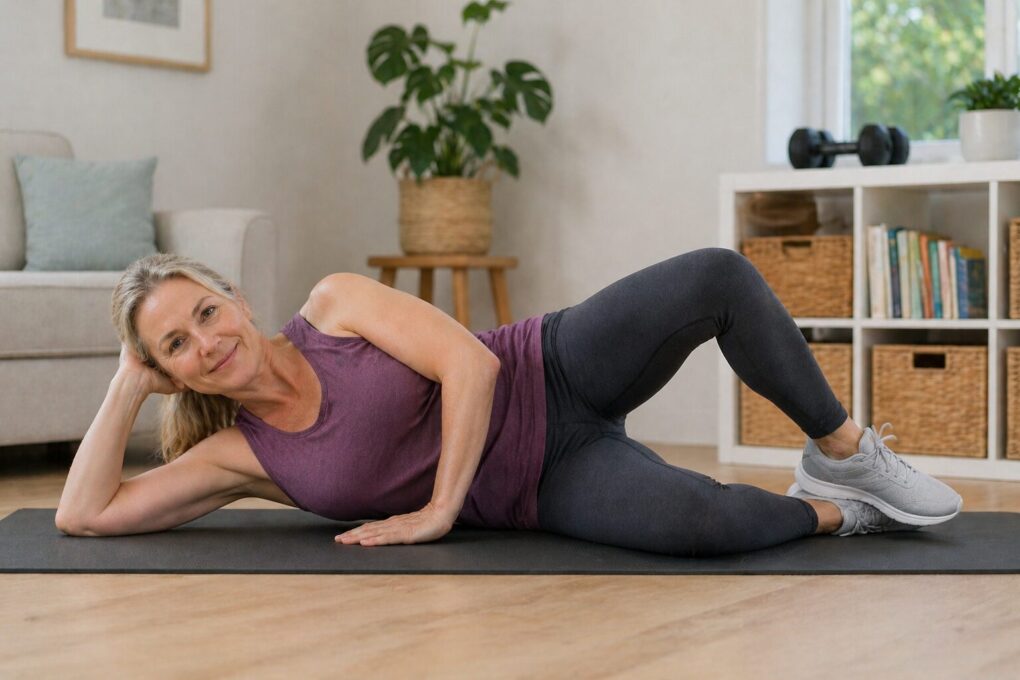
3. Clamshells
Clamshells
BeginnerHip AbductorsNo equipment
Lie on your side with knees bent at about 45 degrees, feet stacked. Keeping your feet together, raise your top knee like a clamshell opening, hold for 2 seconds, lower slowly. Targets the hip abductors and glutes, which are critical for controlling knee alignment during walking and stair-climbing. Hip weakness is a surprisingly frequent driver of knee pain that gets overlooked in most exercise programs.
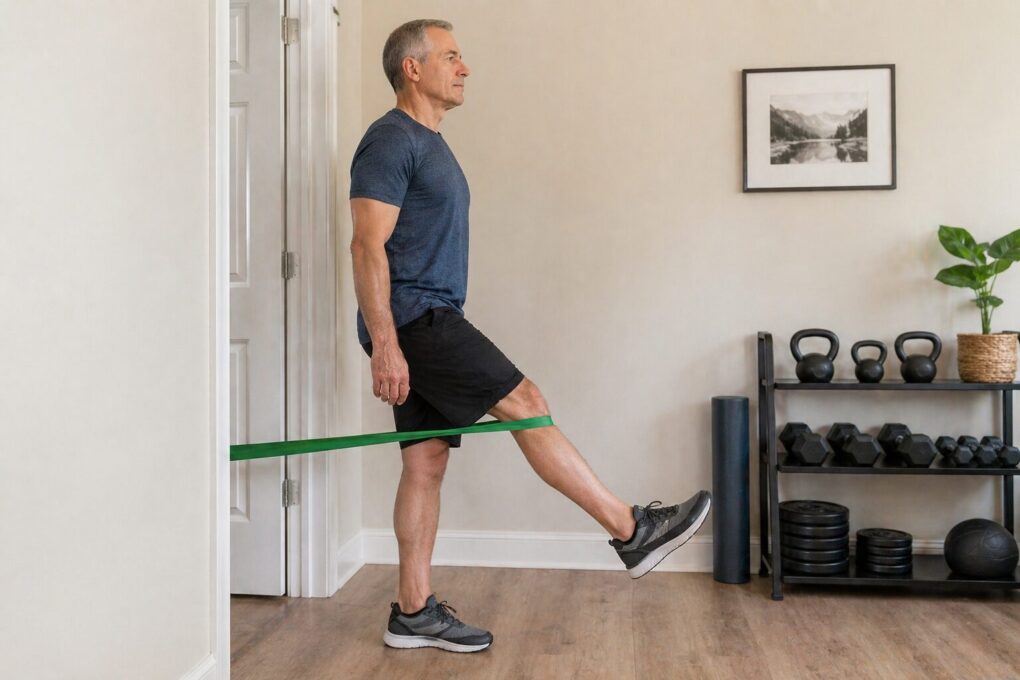
4. Terminal Knee Extensions (TKE)
Terminal Knee Extensions
IntermediateQuadricepsResistance band
Loop a resistance band around something fixed and step into it so the band sits behind your knee. Stand with a slight bend in the knee, then straighten it fully against the band’s resistance, squeezing the quadriceps at the end. This movement specifically targets the terminal extension range, the last 20–30 degrees of straightening, which is often weakened in people with knee pain and is essential for stable walking.
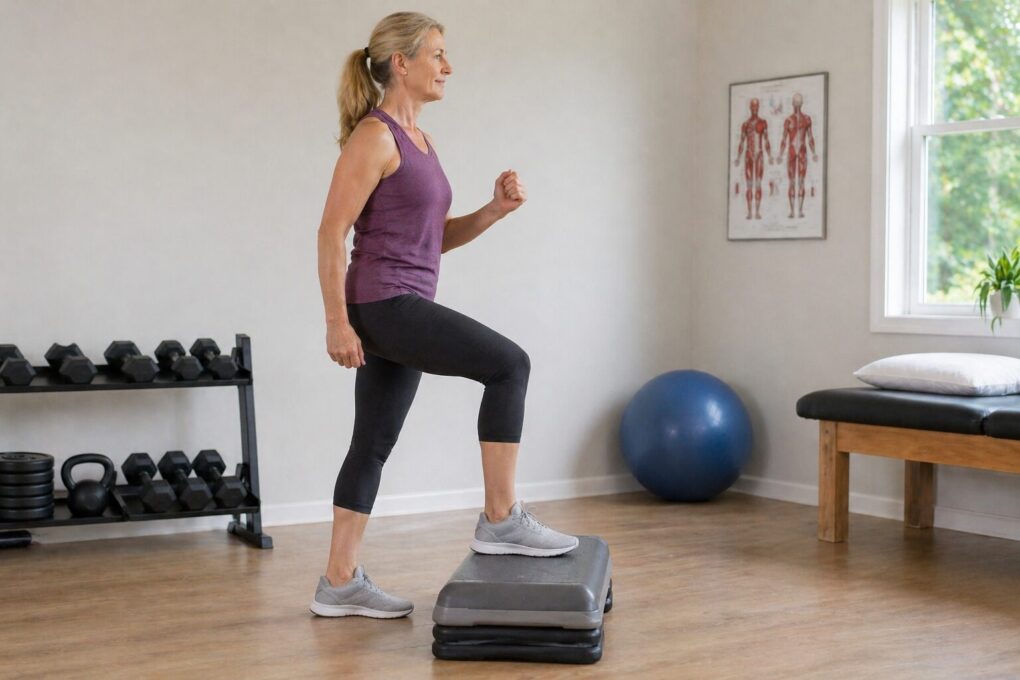
5. Step-Ups
Step-Ups (Low Step)
IntermediateFull Lower BodyFunctional
Use a low step (4–6 inches to start). Step up slowly, control the descent. Step-ups mimic real-world demands, stairs, curbs, uneven terrain, making them one of the most functionally transferable exercises you can do. Keep the movement controlled and the step height low until strength improves. Increase step height over 4–6 weeks as tolerated.
Flexibility and Mobility Work: Often Underestimated
Strengthening without attention to flexibility can create imbalances that worsen knee mechanics. Tight hip flexors, hamstrings, and calf muscles all increase knee stress in ways that are often invisible until pain flares. These mobility exercises pair naturally with the strengthening work above:
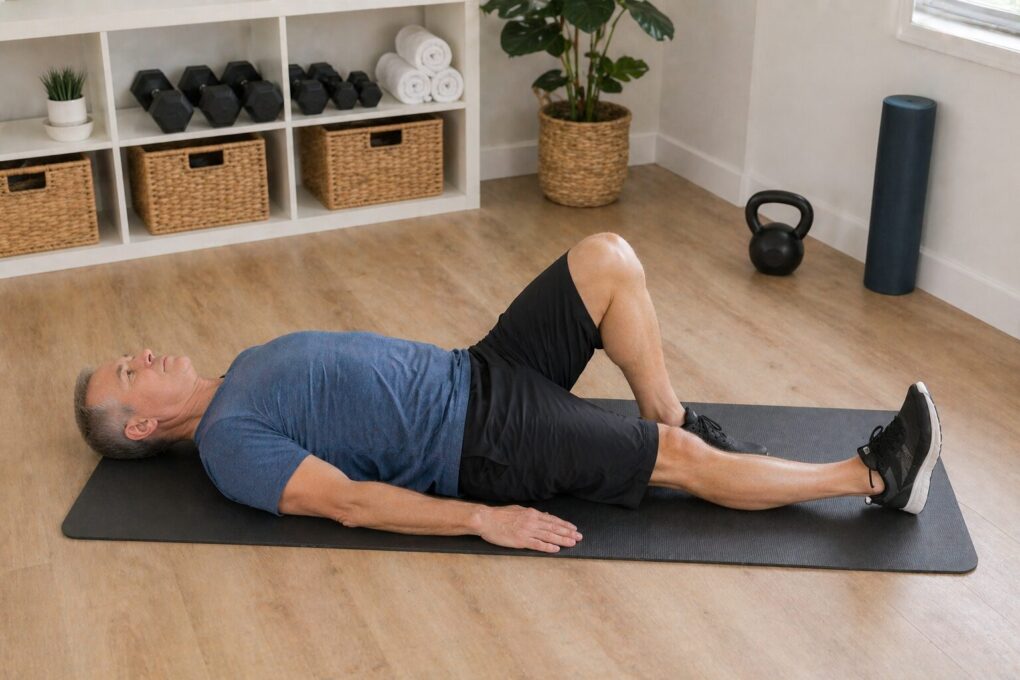
Heel Slides
Lying on your back, slowly slide one heel toward your buttock until you feel a comfortable stretch, hold 5 seconds, slide back. This gently moves the knee through its range of motion, promotes synovial fluid circulation, and helps maintain, or gradually recover, flexion range. Aim for 10–15 repetitions per session.
Standing Quad Stretch
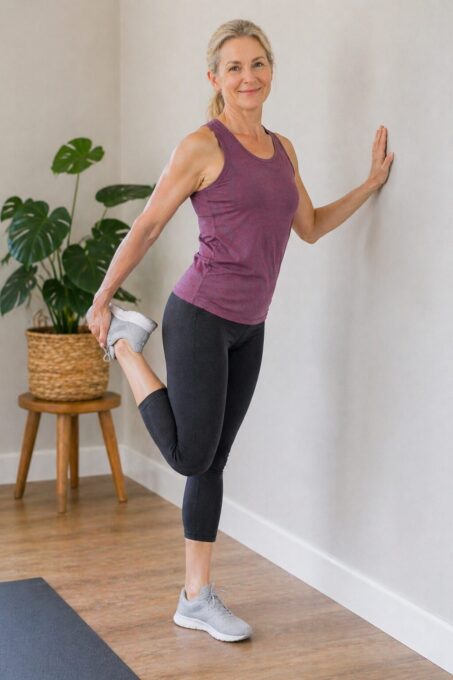
Hold a wall or chair for balance. Bend one knee and hold the ankle behind you, feel the stretch along the front of the thigh, not in the knee. Hold for 30 seconds, 2–3 times per side. Tight quadriceps pull the kneecap (patella) upward and can increase compressive forces on the cartilage beneath it.
Calf Stretches
Place your hands on a wall, one foot back with the heel flat on the ground. Lean gently forward. The Achilles tendon and calf complex influence how force is absorbed through the ankle and distributed upward through the knee. We’ve consistently found that people with unexplained knee pain during walking see meaningful improvement when calf flexibility is restored.
Best Practice
Warm tissue stretches better and carries lower injury risk. Spend 5 minutes walking at an easy pace or cycling gently before doing flexibility work. Save prolonged static stretches (30-second holds) for after your main session when muscles are already warm.
Low-Impact Cardio: Moving More Without Stressing the Joint
Cardiovascular fitness is essential for overall joint health, it supports healthy weight, improves circulation, and reduces systemic inflammation. The key is choosing modalities that minimize impact forces:
| Activity | Joint Impact | Cardio Benefit | Notes |
|---|---|---|---|
| Swimming / Water Aerobics | Minimal | Excellent | Buoyancy offloads up to 90% of body weight; ideal during flare-ups |
| Stationary Cycling | Very Low | Good–Excellent | Adjust seat height so knee bends ~25–35° at the bottom of the pedal stroke |
| Elliptical Trainer | Low | Good | Better than walking for those with severe arthritis; stride length matters |
| Walking (flat surfaces) | Moderate | Good | Short, more frequent walks are better than infrequent long ones |
| Tai Chi | Very Low | Moderate | Strong evidence for balance improvement and pain reduction in knee OA |
Tai chi deserves special mention. Randomized controlled trials conducted at institutions including Tufts Medical Center found that adults with knee osteoarthritis practicing tai chi twice weekly for 12 weeks reported pain reductions comparable to physical therapy — along with improvements in psychological well-being and fall risk. For adults over 50, that combination of benefits is hard to match.
Exercises to Approach with Caution (or Avoid Entirely)
Not every exercise is appropriate when knee pain is present. Some common movements that are perfectly fine for healthy joints can cause significant aggravation for knees with cartilage loss or inflammation:
- Deep squats and lunges: When the knee bends past 90 degrees under load, compressive forces on the patella increase sharply. During a painful period, limit depth to 60–70 degrees maximum.
- Running on hard surfaces: Ground reaction forces during running can reach 2.5–3 times body weight at the knee. If you love running, a treadmill with cushioning or soft trails is significantly better than concrete or asphalt.
- High-impact aerobics and jumping: Plyometric movements generate impact forces the arthritic joint is poorly positioned to absorb. These are not permanently off-limits , but they require a strong strength foundation first.
- Leg press with heavy load and deep bend: The leg press machine is often recommended as a “safe” alternative, but using excessive weight or allowing the knee to travel past 90 degrees replicates the same compressive risks as a deep squat.
- Stair climbing machines at high resistance: Sustained repeated flexion under load can aggravate patellar pain syndromes common in adults over 50.
Important
Sharp, catching, or grinding pain during any exercise is a signal to stop. Mild muscle soreness 24–48 hours after exercise is normal and expected. Joint pain during the movement itself, or swelling and warmth afterward, indicates the load or range exceeded what the joint is currently ready to handle.
Why Knee Pain Becomes More Common After 50: How to Build a Safe and Sustainable Routine
One of the most common mistakes is doing too much, too soon, and then stopping altogether after a flare. Building a routine that you can sustain for months, not just days, requires a progressive structure:
- Start with 3 sessions per week, not daily. Allow rest days between sessions for tissue recovery. For the first two weeks, limit each session to 20–25 minutes.
- Begin at an effort level of 4–5 out of 10. Exercises should feel like mild to moderate effort, not painful, but not trivial either. Many people start too aggressively and experience setbacks within the first two weeks.
- Add one new exercise per week, not several at once. This makes it easy to identify which movements feel good and which may be aggravating your specific pain pattern.
- Progress load or repetitions every 1–2 weeks using the “10% rule”: increase total weekly volume (sets × reps) by no more than 10% per week. This is the evidence-based threshold below which overuse injury risk stays low.
- Track your pain levels with a simple 0–10 scale before and 24 hours after each session. If your pain is consistently higher than 2 points above baseline the next day, you’ve done too much, scale back and progress more slowly.
- At 6–8 weeks, reassess. Most people notice meaningful improvement in pain and function within this window. If you haven’t, that’s clinically significant and warrants evaluation by a physical therapist or sports medicine physician.
In practice, consistency beats intensity in every outcome measure we’re aware of. A 20-minute routine done three times a week for three months will produce far better results than an aggressive program abandoned after two weeks.
The Role of Water Therapy and Aquatic Exercise
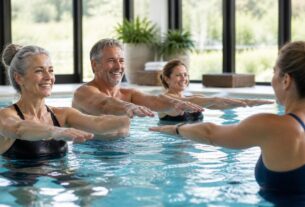
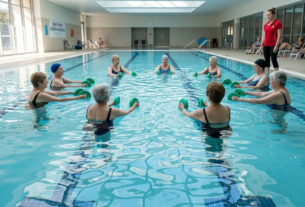
For individuals in significant pain, or those whose pain limits land-based exercise, aquatic therapy deserves serious consideration as a first step. The buoyancy of water reduces effective body weight by up to 80–90% when submerged to chest level, allowing individuals to perform strengthening and range-of-motion exercises that would be impossible or too painful on land.
Research published in journals focused on rheumatology and rehabilitation consistently shows that 8–12 weeks of supervised aquatic exercise produces significant reductions in pain and improvements in function in adults with knee osteoarthritis, with an excellent safety profile and low dropout rates. Many hospital systems and YMCAs across the United States offer aquatic physical therapy programs specifically designed for adults with joint conditions.
Once pain and strength improve enough to transition to land-based exercise, the gains from aquatic therapy carry over well. Many people use aquatic sessions as a permanent complement to their land routine rather than a temporary stepping stone.
When to Stop Exercising on Your Own and See a Specialist
Exercise is powerful, but it has limits, and there are situations where professional evaluation is essential rather than optional:
- Sudden increase in swelling or warmth: This can indicate an acute inflammatory flare or, in rarer cases, conditions like gout, pseudogout, or infection that require prompt medical attention.
- Locking or giving way: If the knee locks in position or suddenly gives out during movement, this suggests potential mechanical problems, meniscus tears, loose bodies, or ligament issues, that need imaging and specialist assessment.
- Pain that wakes you at night: Nocturnal joint pain that is not positional can be a red flag for inflammatory arthritis or other conditions beyond mechanical osteoarthritis.
- No improvement after 8–12 weeks of consistent exercise: A plateau in pain or function after a sustained, well-structured program is a signal that physical therapy, imaging, or other interventions may be needed.
- Rapidly worsening function: If you are losing the ability to perform daily tasks, walking to the mailbox, getting out of a chair, your care should be escalated, not self-managed.
Medical Disclaimer
This article is for informational and educational purposes only. The information provided does not substitute for the guidance of a licensed physician, physical therapist, or other qualified healthcare provider. Before beginning any exercise program, especially if you have existing joint conditions, cardiovascular disease, or other health concerns, consult a qualified healthcare professional. Individual conditions vary significantly, and what is appropriate for one person may not be for another.
Key Takeaways: Moving Forward with Confidence
Managing knee pain after 50 is not about avoiding movement, it’s about choosing the right movement, progressing it intelligently, and sustaining it over time. The exercises outlined here represent the best-supported approaches in current sports medicine and physical therapy research:
- Strengthen the quadriceps, glutes, and hip abductors, these muscles protect the knee from excessive stress during daily activity.
- Prioritize low-impact cardio like cycling, swimming, tai chi, and walking over high-impact alternatives.
- Progress slowly and track your response, the 10% rule and the 24-hour pain check are practical tools that prevent the boom-bust cycles that derail most self-managed programs.
- Flexibility work is not optional, tight hamstrings, hip flexors, and calves alter mechanics in ways that accumulate into pain over months and years.
If you find the information here useful, consider sharing it with someone you know managing knee pain, or saving it as a reference as you build your own routine. And if you’ve found a specific exercise or approach that has worked particularly well for you, we’d genuinely like to hear about it in the comments.
Frequently Asked Questions
How long will it take for exercises to reduce my knee pain?
Most research and clinical experience suggests that meaningful improvement in pain and function becomes noticeable between 4 and 8 weeks of consistent exercise, defined as 3 sessions per week. However, full benefit typically develops over 12–16 weeks. The key word is consistency: sporadic effort produces sporadic results. Don’t judge the program before 6 weeks of regular practice.
Can I exercise when my knee is actively inflamed or swollen?
During an acute flare with significant swelling, range of motion and gentle movement (like heel slides or water walking) are generally safer than resistance training. Rest, ice applied for 15–20 minutes several times a day, and elevation can help resolve acute inflammation within 48–72 hours. Once swelling subsides, gradually return to your routine, starting at a lower intensity than before the flare. If swelling persists beyond 5–7 days, see a physician.
Is walking good or bad for knee pain at my age?
Walking is generally beneficial, but how you walk matters more than whether you walk. Short, frequent walks (15–20 minutes) on flat, cushioned surfaces are better than infrequent long walks on hard pavement. Supportive footwear with adequate cushioning, replaced every 300–500 miles if you walk regularly, makes a measurable difference. A walking pole or single cane (held on the opposite side from the painful knee) can reduce joint load by up to 25%.
Is yoga appropriate for knee pain over 50?
Chair yoga and gentle, modified yoga classes designed for joint pain can be excellent, they combine flexibility, balance, and low-level strength work in a supportive environment. However, many standard yoga poses (deep squats, kneeling poses, lotus position) place significant compressive load on the knee. Always inform your instructor about your knee condition and ask for modifications. “Yoga for arthritis” programs developed in partnership with rheumatologists are the safest starting point.
Should I use a knee brace during exercise?
A knee brace can provide meaningful support during activity for certain conditions — particularly patellofemoral pain syndrome or mild instability, and psychological confidence during exercise. However, braces do not strengthen the muscles that protect the knee, and relying on them long-term without addressing underlying weakness is a short-term solution. For osteoarthritis, an unloader brace (prescribed and fitted by a clinician) has the most evidence; generic compression sleeves provide warmth and proprioceptive feedback but limited structural support.
What is the difference between knee arthritis exercises and general knee exercises?
The core exercises are often the same, quadriceps strengthening, hip strengthening, and flexibility work, but the dosing, progression, and range of motion restrictions differ significantly. With arthritis, you avoid deep knee flexion under load, minimize impact, and progress more conservatively. General knee exercises designed for injury prevention or athletic performance can demand range of motion and load levels that would be inappropriate for someone with moderate to severe osteoarthritis. When in doubt, a physical therapist can design a program calibrated to your specific imaging and functional level.
Can exercise actually prevent or slow down knee arthritis progression?
Evidence strongly supports that regular appropriate exercise slows functional decline in people with existing knee osteoarthritis, meaning it preserves your ability to walk, climb stairs, and live independently for longer. Whether it structurally slows cartilage loss is more complex and still under active research. What is clear is that physical inactivity accelerates muscle loss, weight gain, and inflammatory processes that collectively worsen arthritis. For most adults over 50, the risk-benefit calculation strongly favors staying active over resting.

Lauren is the founder of PainFreeAfter50.com and a dedicated researcher in joint health and healthy aging. After developing chronic joint pain in her early 50s, she spent years reviewing clinical studies and testing natural approaches to find real solutions. Today she shares honest, evidence-based guidance to help adults over 50 manage pain, improve mobility, and reclaim their quality of life.