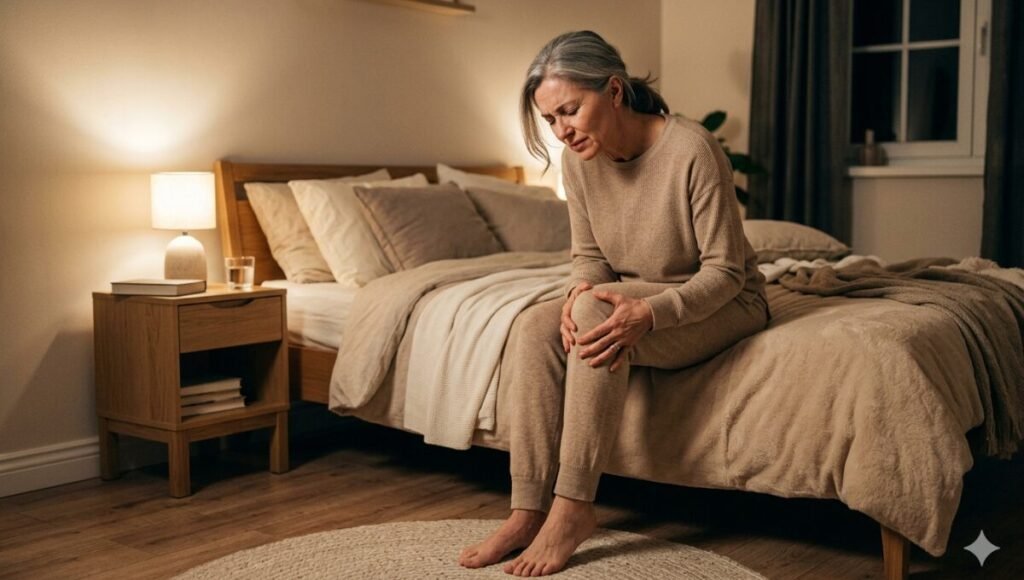
If you are over 50 and lying awake at night because your knees are throbbing, aching, or stiffening up, I want you to know you are not alone, and you are absolutely in the right place. Knee pain at night after 50 is one of the most common complaints I hear from people in this stage of life, and for a long time, it was something I struggled with personally too.
That dull, deep ache that starts just as you finally settle in to rest? It is exhausting in the most frustrating kind of way.
What makes it especially confusing is that you may have walked through your entire day without much trouble, and then the moment you lie down, your knees decide to announce themselves. I have been there. And once I understood why it happens and what actually helps, everything changed.
This article is my honest breakdown of what causes knee pain at night after 50, what the research says, and what real relief looks like. Not quick fixes. Not miracle promises. Just practical, grounded information that can genuinely make a difference.
What Causes Knee Pain at Night After 50?
Featured Snippet Question: Why do knees hurt more at night after age 50?
After 50, knees hurt more at night because cartilage thins, inflammation increases during rest, and reduced circulation slows joint recovery. Hormonal shifts and inactivity during sleep also reduce natural lubrication in the joint, intensifying discomfort that feels manageable during the day.
Cartilage Breakdown and Osteoarthritis
The most common culprit behind knee pain at night after 50 is osteoarthritis. As we age, the cartilage that cushions the ends of our bones gradually wears down. During the day, movement helps stimulate joint fluid production, which keeps things lubricated. But when you stop moving at night, that natural cushioning effect diminishes, and the inflammation that has been building throughout the day has nowhere to go.
I remember the first time my doctor told me my knee X-rays showed early osteoarthritis. I was 52 and felt like the floor had dropped out from under me. But understanding what was actually happening in my joints helped me stop feeling helpless about it.
Key signs of osteoarthritis-related knee pain at night:
- Stiffness when you first wake up or after sitting for long periods
- A dull, deep ache rather than a sharp pain
- Mild swelling around the knee joint
- Pain that improves slightly once you get moving
Bursitis: When the Cushions Get Inflamed
Bursae are small fluid-filled sacs that act as cushions between bones and soft tissues in your knee. When they become inflamed a condition called “bursitis,” they can cause significant pain, especially when you lie in certain positions at night. Side sleepers, in particular, may notice this more acutely because the weight of one knee pressing against the other irritates those inflamed sacs.
Hormonal Changes and Inflammation After 50
This one does not get talked about enough, especially for women. After menopause, estrogen levels drop significantly, and estrogen plays a real role in managing inflammation throughout the body, including in the joints. Many women find that knee pain at night after 50 worsens noticeably after menopause, and there is real science behind why that happens.
For men, declining testosterone after 50 also contributes to muscle loss around the knee, which puts more stress on the joint itself.
The Role of Lifestyle in Nighttime Knee Pain
How Your Daytime Habits Affect Your Nights
What you do during the day has a direct impact on how your knees feel when you try to sleep. High-impact activities without proper support, prolonged sitting with your knees bent, or even wearing the wrong footwear can all accumulate into nighttime pain.
Here is a simple breakdown of common daytime habits and their nighttime impact:
| Daytime Habit | Nighttime Effect |
|---|---|
| Prolonged sitting (knees bent 90°) | Increased stiffness and aching at rest |
| High-impact exercise without support | Inflammation that peaks during sleep |
| Poor footwear | Misalignment that stresses the knee joint |
| Dehydration | Reduced joint lubrication |
| Sedentary lifestyle | Weakened supporting muscles, more joint strain |
Weight, Pressure, and the Knee Joint
For every pound of body weight you carry, your knee absorbs roughly four pounds of pressure during daily movement. By the time you lie down at night, your joints have been carrying that load for hours. Even a modest weight reduction of 10 to 15 pounds can make a measurable difference in how your knees feel, including at night.
I am not saying this to shame anyone. I had to confront my own weight after 50, and it was not easy. But when I made even modest changes, the relief in my knees at night was real and noticeable.
Sleep Position Matters More Than You Think
The position you sleep in can either aggravate or ease knee pain at night after 50. Sleeping on your back with a pillow under your knees takes pressure off the joint and keeps it in a neutral position. Side sleepers benefit enormously from placing a supportive pillow between their knees; it prevents the knees from pressing together and keeps the hips and spine aligned.
Stomach sleeping is generally the worst position for knee health because it hyperextends the joint and places stress on the entire lower body chain.
Effective Relief Strategies for Knee Pain at Night After 50
Non-Medication Approaches That Actually Work
Before reaching for a pill bottle every night, there are several evidence-supported strategies worth building into your routine.
Cold and heat therapy: Ice applied for 15 to 20 minutes after activity can reduce inflammation before bedtime. Heat a warm compress or heating pad relaxes stiff muscles and improves circulation around the joint. I personally alternate between the two depending on whether my knee feels more inflamed or more stiff.
Elevation: Elevating your legs slightly while lying down helps reduce fluid buildup around the knee and can ease that heavy, throbbing sensation.
Supportive pillows: Investing in a good orthopedic knee pillow changed my nighttime experience dramatically. The right pillow keeps your knees aligned and reduces the micro-pressures that build up over hours of sleep.
Gentle stretching before bed: A short 5- to 10-minute routine focused on the quadriceps, hamstrings, and calves can significantly reduce the overnight stiffness that comes with knee pain after 50. Yoga-based stretches like legs-up-the-wall or a gentle supine hamstring stretch are particularly effective.
Supplements and Nutritional Support
Several supplements have meaningful evidence behind them for joint health:
- Glucosamine and chondroitin: Among the most studied for osteoarthritis; help support cartilage integrity
- Omega-3 fatty acids: Strong anti-inflammatory properties; particularly helpful for reducing overnight inflammation
- Turmeric/curcumin: Natural anti-inflammatory with growing research support
- Collagen peptides: Emerging evidence suggests they support joint tissue, especially in combination with vitamin C
- Magnesium: Helps with muscle relaxation overnight, which can ease the tension around the knee joint
Always talk with your doctor before starting new supplements, especially if you take medications. That said, these are not fringe ideas; they are widely used and increasingly supported by clinical data.
When to Consider Medical Treatment
If your knee pain at night after 50 is severe, consistent, or interfering with your sleep and quality of life, it is time to have a real conversation with your healthcare provider. Effective medical options include:
- Corticosteroid injections for acute inflammation
- Hyaluronic acid injections to supplement joint fluid
- Physical therapy tailored to your specific knee mechanics
- Prescription anti-inflammatories for short-term relief
- In advanced cases, surgical consultation for joint repair or replacement
Do not wait until the pain is unbearable. Early intervention almost always produces better outcomes.
Exercise: The Right Movement for Knee Health After 50
Low-Impact Activities That Protect Your Joints
Movement is medicine for arthritic knees, but the type of movement matters enormously. High-impact activities like running or jumping can accelerate cartilage wear. Low-impact options protect the joint while building the muscular support it needs.
Best low-impact exercises for knee pain after 50:
- Swimming and water aerobics (near-zero joint impact)
- Cycling (stationary or outdoor, with proper seat height)
- Walking on level surfaces with supportive footwear
- Tai chi (proven to reduce knee pain and improve balance in older adults)
- Yoga (gentle, joint-focused classes designed for people over 50)
Strengthening the Muscles Around the Knee
Strong quadriceps and hamstrings act as shock absorbers for your knee joint. When these muscles are weak, which happens naturally with age if we are not actively working against it, the knee takes on more load than it should. Even 15 minutes of targeted strengthening three times a week can make a significant impact on nighttime knee pain after 50.
Simple exercises to start with:
- Seated leg raises
- Wall sits (partial range of motion)
- Clamshells (for hip and knee stability)
- Step-ups on a low step
Building a Nighttime Routine That Supports Your Knees
A Simple Pre-Sleep Protocol
Over time, I built a consistent before-bed routine that genuinely reduced my knee pain at night. Here is what works for me and many others in the over-50 community:
- Apply a heat compress to your knees for 10 to 15 minutes after dinner
- Do a gentle 5-minute stretching routine focused on hamstrings and quads
- Take any nighttime supplements (magnesium, omega-3s) with a glass of water
- Set up your sleep environment: a supportive pillow between or under your knees
- Avoid prolonged sitting in the two hours before bed; if you watch TV, elevate your legs
None of these steps are dramatic. But consistency is everything. The nights I skip this routine, I feel the difference immediately.
Tracking Your Triggers
Keeping a simple journal, even just a note on your phone, of what you ate, how much you moved, and how your knees felt that night can reveal patterns you would never notice otherwise. Some people find that certain foods (refined sugar, processed carbohydrates, and alcohol) reliably worsen their knee inflammation. Others discover that a specific type of shoe or a long car ride is a consistent trigger.
Personalization is the real key to managing knee pain at night after 50. There is no one-size-fits-all solution, but there is absolutely a solution that fits you.
Frozen Shoulder After 50: What It Is and How Long It Lasts

Conclusion: You Do Not Have to Accept Sleepless Nights as Your New Normal
Knee pain at night after 50 is real, common, and most importantly, manageable. Understanding that it often comes from a combination of cartilage changes, inflammation, hormonal shifts, and lifestyle factors gives you real power to address it from multiple angles at once.
Start with what you can control tonight: your sleep position, a supportive pillow, a gentle stretch before bed, and a heating pad. Then layer in the bigger changes: targeted exercise, nutrition, supplements, and, if needed, professional care. These things compound over time.
You do not have to white-knuckle your way through every night. Knee pain at night after 50 responds to the right kind of consistent attention, and the relief you are looking for is genuinely within reach.
Thank you so much for reading this far. I know how draining it is to search for real answers when you are dealing with knee pain at night after 50, and I hope what you found here actually helps you sleep a little easier tonight. If this article made a difference for you, share it with someone else who might need it.

Lauren is the founder of PainFreeAfter50.com and a dedicated researcher in joint health and healthy aging. After developing chronic joint pain in her early 50s, she spent years reviewing clinical studies and testing natural approaches to find real solutions. Today she shares honest, evidence-based guidance to help adults over 50 manage pain, improve mobility, and reclaim their quality of life.