Does it take longer than it used to for your body to “warm up” in the morning? Do your hips feel tight when you stand up from a chair, or do your knees protest on the stairs? You’re not imagining it, and you’re definitely not alone.
After 50, changes in muscle elasticity, joint lubrication, and connective tissue mean that mobility can decline, sometimes gradually, sometimes noticeably fast. But here’s the good news: mobility is trainable at any age. A few minutes of the right movements each day can make a genuine, measurable difference in how freely and comfortably you move.
This guide walks you through simple daily exercises to improve mobility after 50, rooted in evidence-based movement principles and designed for real bodies, not athlete bodies.
What exactly is “mobility” and why does it matter after 50?
Mobility is your joints’ ability to move through their full, pain-free range of motion actively controlled by your muscles. It differs from flexibility (passive lengthening of muscles) and is more directly tied to functional daily life: reaching overhead, bending to pick something up, stepping over a curb, or climbing stairs without gripping the railing.
Poor mobility after 50 is associated with a higher risk of falls, joint pain, and loss of independence. The American College of Sports Medicine recommends flexibility and mobility training at least 2–3 days per week for adults over 50.
Why Mobility Declines After 50 (And What You Can Actually Do About It)
Starting around age 30, adults lose roughly 3–8% of muscle mass per decade, a process called “sarcopenia.” But the less-discussed companion is the stiffening of connective tissue: tendons, ligaments, and the fascia that wraps around your muscles all become less elastic with age.
For women over 50, estrogen loss during and after menopause accelerates these changes, particularly in joint cartilage and connective tissue. This is one reason many women notice a sudden increase in morning stiffness or joint discomfort in their 50s.
Here’s what the research tells us:
- Regular movement increases synovial fluid production, which lubricates your joints
- Dynamic stretching and mobility work can restore meaningful range of motion even after years of stiffness
- Consistent low-intensity daily movement outperforms occasional intense sessions for joint health
Before You Start: A Few Practical Notes
- Check with your doctor first if you have osteoporosis, osteoarthritis, a recent joint replacement, or balance issues
- Pain is a stop sign. Mild tension or mild discomfort is normal; sharp or worsening pain is not
- Move slowly and with control. Momentum does the work for you, not your joints
- Morning stiffness is real; a short warm walk or hot shower before these exercises can help
7 Simple Daily Exercises to Improve Mobility After 50
This routine targets the most commonly stiff areas in adults over 50: hips, thoracic spine, ankles, shoulders, and knees. It takes 10–15 minutes and requires no equipment.
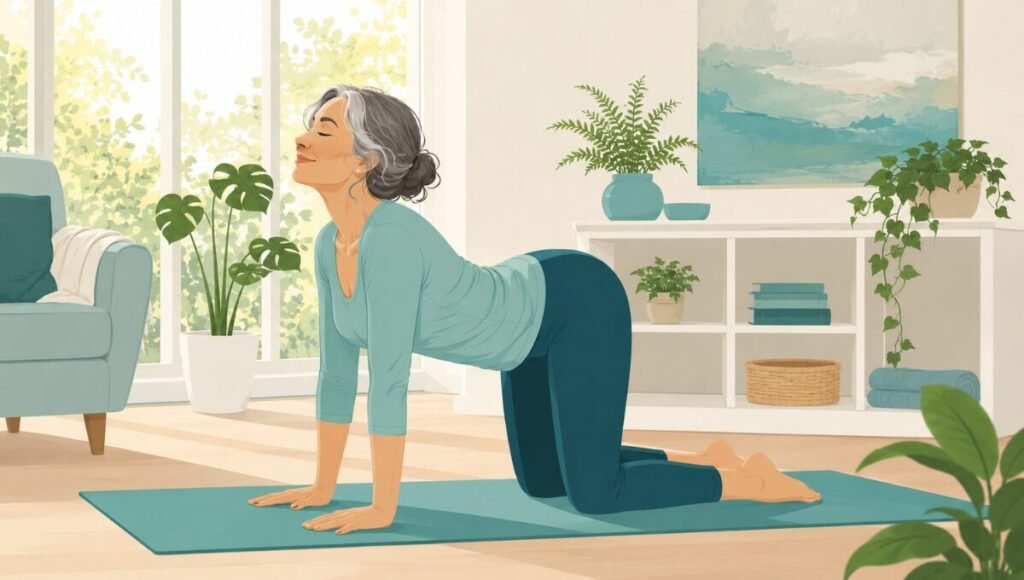
1. Cat-Cow Stretch (Spinal Mobility)
Targets: Thoracic and lumbar spine, neck
How to do it: Start on all fours with your hands under your shoulders and knees under your hips. Inhale as you drop your belly toward the floor and lift your head and tailbone (Cow). Exhale as you round your back toward the ceiling, tucking your chin and tailbone (cat). Move slowly and breathe through each transition.
- Reps: 8–10 slow breath cycles
- Modification: Do this seated in a chair arch and round your lower back instead
2. Hip Circles (Hip Joint Mobility)
Targets: Hip joint, hip flexors, glutes
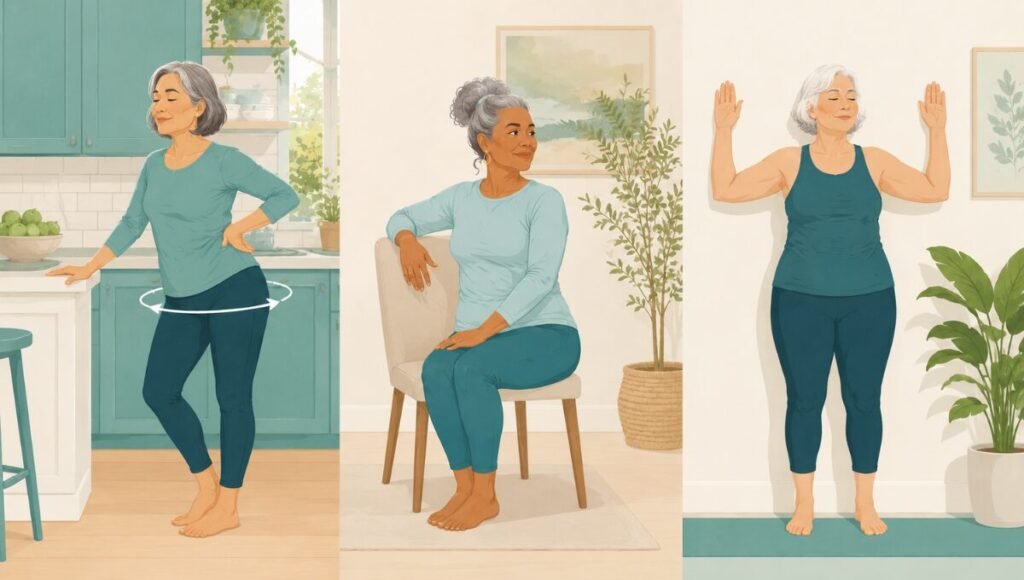
How to do it: Stand with feet hip-width apart and hands on your hips. Slowly draw large circles with your hips 5 clockwise, then 5 counterclockwise. Keep your upper body relatively still and focus on moving the hip joint, not your whole torso.
- Reps: 5 each direction, both sides
- Tip: Hold a countertop or chair back if balance is a concern
3. Thoracic Rotation (Upper Back Mobility)
Targets: Mid-back (thoracic spine), shoulders
How to do it: Sit upright in a chair with your feet flat on the floor. Cross your arms over your chest. Slowly rotate your upper body to the right as far as comfortable, hold for 2 seconds, return to center, then rotate left. Keep your hips facing forward throughout.
- Reps: 8–10 each side
- Why it matters: Stiffness here affects your ability to turn to check traffic and reach behind you, and is a major contributor to upper back pain
4. Standing Ankle Circles (Ankle & Lower Leg Mobility)
Targets: Ankle joint, calves, Achilles tendon
How to do it: Hold a wall or chair for support. Lift one foot slightly off the floor and draw slow, controlled circles with your foot: 5 clockwise and 5 counterclockwise. Switch feet.
- Reps: 5 circles each direction, each foot
- Why it matters: Ankle mobility is directly linked to fall prevention; stiff ankles impair your ability to self-correct your balance
5. Seated Knee Extensions (Knee & Quad Mobility)
Targets: Knee joint, quadriceps
How to do it: Sit in a chair with your back against the backrest. Slowly extend one leg until it’s as straight as comfortable, not locked. Hold for 2–3 seconds at the top, then slowly lower it. Focus on the squeeze in the front of your thigh.
- Reps: 10 each leg, 1–2 sets
- Modification: Place a rolled towel under the knee if it’s uncomfortable
6. Wall Shoulder Slides (Shoulder Mobility)
Targets: Shoulder joint, rotator cuff, upper back
How to do it: Stand with your back against a wall, arms bent at 90 degrees (like a “W” shape), elbows and wrists touching the wall. Slowly slide your arms upward along the wall until they form a “Y” shape, keeping contact as best you can. Hold 2 seconds at the top, then slowly lower.
- Reps: 8–10 slow reps
- Tip: Your arms don’t need to stay flat against the wall the whole time; go as far as comfortable
 Pedal Exerciser Bike for Seniors | 
|
|---|---|
7. Standing Hip Flexor Stretch with Reach (Hip Flexor & Spine Mobility)
Targets: Hip flexors, iliopsoas, lumbar spine
How to do it: Step one foot forward into a gentle lunge stance. Keep your back knee slightly bent and your front knee directly over your ankle. Gently push your hips forward until you feel a stretch in the front of your back hip. Simultaneously reach the arm on your back-leg side overhead and slightly back. Hold 20–30 seconds.
- Hold: 20–30 seconds each side, 2 times
- Why it matters: Tight hip flexors from sitting are one of the most common causes of lower back pain and poor posture after 50
Quick-Reference: Your Daily Mobility Routine at a Glance
| Exercise | Target Area | Reps / Hold | Modification |
|---|---|---|---|
| Cat-Cow Stretch | Spine | 8–10 breaths | Seated in chair |
| Hip Circles | Hips | 5 each direction | Hold chair for balance |
| Thoracic Rotation | Upper back | 8–10 each side | Already seated |
| Ankle Circles | Ankles | 5 each direction/foot | Hold wall |
| Seated Knee Extensions | Knees / Quads | 10 each leg | Towel under knee |
| Wall Shoulder Slides | Shoulders | 8–10 reps | Partial range OK |
| Hip Flexor Stretch | Hips / Spine | 20–30 sec × 2/side | Hands on chair |
How to Build a Consistent Mobility Habit
Consistency beats intensity every time for mobility training. Here’s a practical approach:
- Attach it to an existing habit: Do your mobility routine right after brushing your teeth, with your morning coffee, or before watching evening TV
- Start with just 3 exercises and build up: You’re more likely to stick with something that feels manageable
- Track progress with a simple journal: Note how far you can rotate and how deep your hip stretch is. Small improvements motivate continued effort
- Expect results within 2–4 weeks: Most people notice measurable improvements in range of motion and morning stiffness within the first month
Mobility doesn’t have to be complicated, and it doesn’t have to take an hour at the gym. Ten to fifteen minutes of intentional movement each day, focused on the exercises above, can genuinely transform how you feel in your body over the weeks and months ahead.
The goal isn’t to move the way you did at 30. It’s about moving as freely and comfortably as possible right now and protecting that ability for years to come. You have more control over that than you might think.
Start today with just one exercise, maybe the cat-cow stretch or the hip circles, and build from there. Your joints will thank you.
Frequently Asked Questions
How long does it take to improve mobility after 50?
Most people begin to notice improvements in range of motion and reduced stiffness within 2–4 weeks of consistent daily practice. Meaningful functional gains like easier stair-climbing or better balance typically develop within 6–8 weeks.
Is it safe to do mobility exercises every day?
Yes, gentle mobility work like the exercises in this guide is generally safe to do daily. Unlike strength training, it doesn’t create the muscle breakdown that requires rest days. If you experience joint soreness that persists more than 24 hours, reduce your frequency or intensity.
What’s the difference between mobility exercises and stretching?
Stretching is passive; you lengthen a muscle and hold it. Mobility training is active you move a joint through its range of motion under muscular control. Mobility work tends to have stronger carryover to real-life movement because it trains both the range and the strength within that range.
Can I do these exercises if I have arthritis or a joint replacement?
Many people with arthritis benefit greatly from gentle mobility work, as movement keeps joints lubricated and reduces stiffness. However, always check with your doctor or physical therapist first, especially if you’ve had a joint replacement. They can guide you on any movements to avoid or modify.
When to See a Physical Therapist
Self-guided mobility work is excellent for general stiffness and maintenance, but there are situations where a physical therapist can provide far more targeted help:
You have significant pain during or after movement
Stiffness is asymmetrical (one side much worse than the other)
You’ve had a recent fall or feel unsteady
You have a diagnosed condition like osteoporosis, spinal stenosis, or severe osteoarthritis
Final Thoughts: Start Small, Stay Consistent
Medical Disclaimer: This content is for informational and educational purposes only and does not constitute medical advice. Always consult a qualified healthcare provider before beginning a new exercise program, especially if you have an existing health condition, recent injury, or joint replacement.

Lauren is the founder of PainFreeAfter50.com and a dedicated researcher in joint health and healthy aging. After developing chronic joint pain in her early 50s, she spent years reviewing clinical studies and testing natural approaches to find real solutions. Today she shares honest, evidence-based guidance to help adults over 50 manage pain, improve mobility, and reclaim their quality of life.