
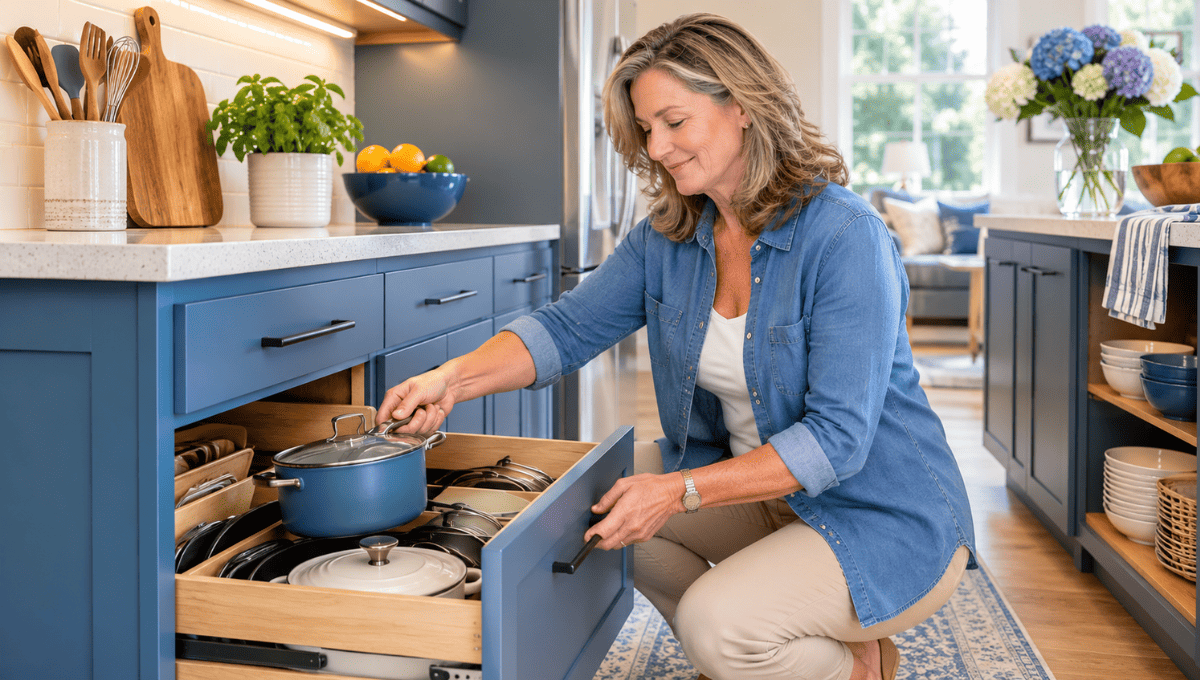
Kitchen Organization Tips to Reduce Back Strain. A well-organized kitchen can make everyday tasks easier, faster, and more comfortable, especially as we get older. The way you store dishes, cookware, food, and appliances can influence how often you bend, reach, twist, lift, or stand in awkward positions.
If your kitchen requires you to repeatedly bend down for heavy pots, reach above shoulder level for everyday items, or twist your body while unloading the dishwasher, a few simple organizational changes may make a noticeable difference.
The good news is that you do not need to remodel your entire kitchen.
Small changes in where and how you store frequently used items can help reduce unnecessary bending, reaching, and awkward movements during everyday kitchen routines.
Here are practical kitchen organization tips to help create a more comfortable and back-friendly space.
Kitchen Organization Tips to Reduce Back Strain: Why Kitchen Organization Matters for Your Back
Kitchen tasks often involve repetitive movements.
Think about a typical meal preparation routine. You may open a lower cabinet, bend down to find a pan, reach into the refrigerator, lift ingredients onto the counter, unload dishes from the dishwasher, and repeatedly turn between different work areas.
None of these movements is necessarily a problem on its own. The challenge can come from doing them repeatedly throughout the day.
Poor kitchen organization can encourage:
- Frequent bending toward low cabinets
- Reaching overhead for everyday items
- Twisting while carrying dishes or cookware
- Lifting heavy objects from awkward positions
- Standing for long periods without changing position
- Reaching across deep counters or crowded workspaces
A more intentional layout can reduce some of these unnecessary movements.
The goal is not to eliminate movement from your kitchen. Instead, it is to make the movements you perform every day more natural and manageable.
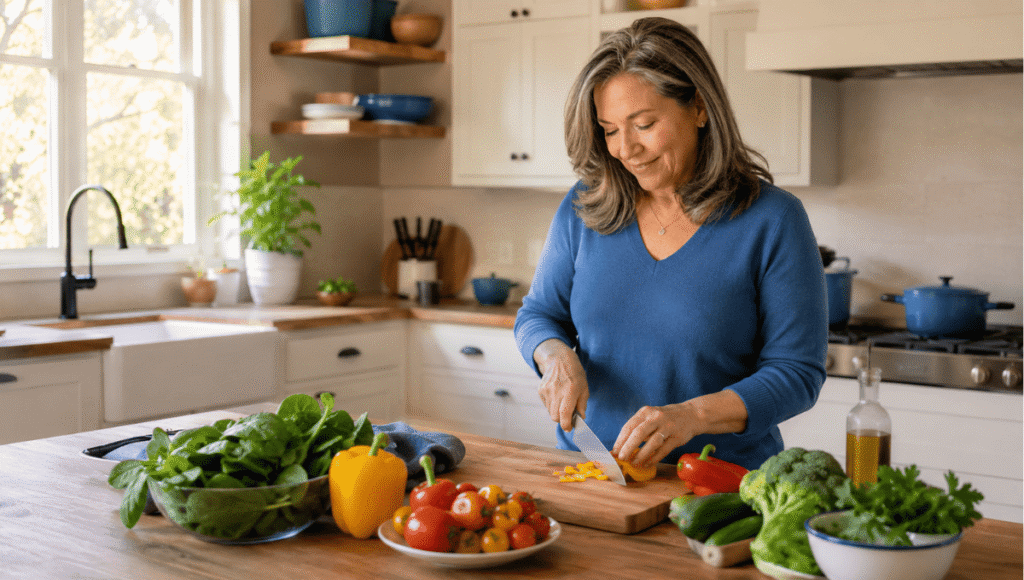
1. Keep Frequently Used Items Between Waist and Shoulder Height
One of the simplest kitchen organization strategies is to store your most frequently used items in the easiest-to-reach areas.
Think about what you use almost every day:
- Plates
- Drinking glasses
- Coffee mugs
- Cooking utensils
- Cutting boards
- Everyday pans
- Frequently used ingredients
- Small appliances
Whenever possible, place these items in cabinets or drawers that do not require you to repeatedly bend deeply or reach overhead.
Items that are used only occasionally can go in less convenient storage spaces.
This creates a simple hierarchy:
Daily-use items = easiest access.
Occasional-use items = less convenient storage.
You may be surprised by how much easier your kitchen feels when you stop storing everyday objects in the hardest-to-reach places.
2. Move Heavy Cookware Out of Low Cabinets
Large pots, Dutch ovens, cast-iron cookware, and countertop appliances can be surprisingly heavy. If these items are stored in a cabinet close to the floor, you may have to bend down and lift them from a low position. Instead, consider moving heavier cookware to a more accessible location.
For example, you might use:
- A waist-height cabinet
- A sturdy drawer designed for cookware
- A shelf with easy access
- A rolling cart
- A designated cookware area close to your main preparation space
The important point is to make sure the storage surface is strong enough for the weight. You also do not need to keep every pot and pan in the most convenient location. Prioritize the cookware you use most often. A large roasting pan that comes out twice a year can stay somewhere less accessible. Your everyday saucepan probably should not.
3. Use Drawers Instead of Deep Lower Cabinets When Possible
Deep lower cabinets can become difficult storage zones. Items disappear toward the back, which means you may have to bend down, reach forward, and search through several objects to find what you need.
Drawers can make this process easier because they bring the contents toward you. If you cannot replace your cabinets, inexpensive organizational solutions may still help.
Consider using:
- Pull-out shelves
- Sliding baskets
- Cabinet organizers
- Dividers
- Adjustable racks
The goal is to make the contents visible and accessible without requiring you to reach deeply into the cabinet.
When organizing a lower cabinet, place the heavier objects toward the front only if the shelving system is stable and designed to support them. Avoid overloading drawers or shelves.
4. Create a “Most-Used” Kitchen Zone
One of the best ways to simplify kitchen organization is to think in terms of zones. Instead of organizing everything according to the type of object, organize some items according to how often and where you use them.
For example, your main cooking zone might include:
- Your everyday cutting board
- Favorite knife
- Cooking utensils
- Frequently used spices
- Olive oil
- Everyday saucepan
- Measuring tools
Keep these items close to the area where you prepare food. This reduces the number of times you have to walk across the kitchen, reach into distant cabinets, or carry objects from one side of the room to another.
A well-designed kitchen does not necessarily require more storage. It requires better access to the storage you already have.
5. Store Heavy Items at a Comfortable Height
Storage height matters even more when an object is heavy. A lightweight container may not be difficult to retrieve from a high shelf. A large bag of flour or heavy appliance can be much more awkward.
As a general organizational principle, keep heavier everyday items in locations where you can retrieve them without excessive bending or overhead reaching.
For example, instead of placing a heavy countertop appliance on a high shelf, consider keeping it on a stable surface or in an easily accessible cabinet.
You can also divide heavy items into smaller containers when appropriate.
For example, rather than repeatedly lifting a large container of a pantry staple, you might keep a smaller working container in an accessible location and store the larger supply elsewhere.
6. Make Your Refrigerator Easier to Use
The refrigerator is one of the most frequently accessed areas in many kitchens. Yet refrigerator organization is often overlooked.
If you constantly bend down to find food or reach awkwardly into the back of a shelf, reorganizing the refrigerator can make daily routines easier.
Try placing frequently used foods where they are easiest for you to see and reach. You can use clear bins to group similar items, such as:
- Breakfast foods
- Snacks
- Produce
- Condiments
- Meal-prep ingredients
Avoid packing shelves so tightly that you have to move several containers just to reach one item. Visibility is an important part of organization. When you can see what you have, you are less likely to repeatedly reach, bend, and rearrange items while searching.
7. Organize the Dishwasher With Less Bending in Mind
Unloading the dishwasher is another routine task that can involve repeated bending and twisting. A simple strategy is to think about where each category of dish belongs before you start unloading.
For example, keep plates together, glasses together, and utensils together. This can reduce unnecessary movement around the kitchen.
If possible, place commonly used dishes in cabinets close to the dishwasher. That way, you can move dishes only a short distance instead of carrying them across the kitchen.
You can also consider storing everyday plates and bowls in an easily accessible drawer or cabinet rather than in a location that requires frequent overhead reaching.
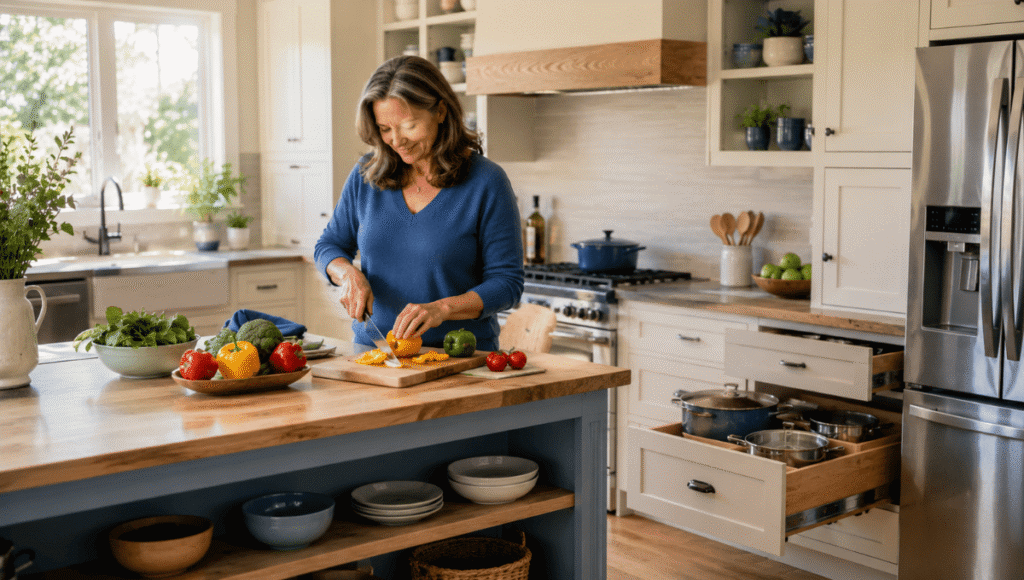
8. Avoid Creating a “Kitchen Floor Storage” Problem
Kitchen floors can become temporary storage areas surprisingly quickly. Bags, appliances, boxes, pet supplies, recycling bins, and bulk food containers can accumulate on the floor.
Every item on the floor can potentially become something you need to step around, move, or pick up. Instead, look for permanent storage solutions.
If you frequently buy large packages, consider creating a dedicated pantry area or storage shelf. If recycling containers are constantly in your way, rethink their location.
If an appliance is sitting on the floor because there is no convenient place for it, ask whether you actually use it often enough to justify keeping it.
Decluttering is not just about making a kitchen look better. It can also make the space easier to navigate.
9. Reduce Reaching Across the Counter
A crowded countertop can encourage awkward reaching. If frequently used objects are positioned far away, you may repeatedly lean or stretch across the counter to retrieve them.
Instead, keep your most frequently used items close to your primary preparation area. For example, if you use a cutting board every day, store it where you can retrieve it easily.
If you regularly use a particular cooking utensil, place it in a nearby drawer or container. The objective is simple:
Bring the tools to you instead of constantly reaching for the tools.
10. Use a Rolling Cart for Frequently Used Items
A rolling kitchen cart can be useful when storage is limited. It can hold frequently used items and move between areas of the kitchen when necessary.
For example, a cart might be used for:
- Coffee supplies
- Baking equipment
- Frequently used pantry items
- Small appliances
- Meal-preparation supplies
Choose a stable cart with wheels that move smoothly and lock securely when needed. Avoid making the cart excessively heavy. The goal is easier access, not creating another heavy object that has to be pushed or pulled.
11. Declutter Before Buying More Organizers
It is tempting to solve every kitchen-storage problem by purchasing another organizer. But sometimes the best organizational tool is simply removing things you no longer use.
Open one cabinet at a time and ask:
Have I used this during the past year?
Would I buy this again today?
Is it worth storing in one of my easiest-to-reach spaces?
You may discover that some of your most valuable storage space is occupied by objects you rarely use. Once unnecessary items are removed, frequently used kitchen tools can often be moved into more accessible locations without buying anything.
12. Think About Your Kitchen in Terms of Movement
A back-friendly kitchen is not simply a kitchen with neat cabinets. It is a kitchen that supports the way you actually move.
Pay attention to the tasks you perform repeatedly. Do you bend down every morning to get your coffee supplies?
Do you reach overhead for the same plates every evening? Do you have to carry heavy cookware across the kitchen?
Do you repeatedly twist between the refrigerator and counter? These observations can reveal the best organizational changes.
You do not need to reorganize the entire kitchen in one afternoon. Choose the movement that feels most inconvenient and change the storage arrangement around it. Then observe whether the new setup works better.
13. Keep Kitchen Work at a Comfortable Level
Counter height cannot always be changed, especially in a rental or existing kitchen. However, you can pay attention to how you position yourself while preparing food.
Whenever possible, avoid working for long periods while leaning forward over the counter. Keep commonly used ingredients and tools within comfortable reach.
For tasks that take longer, consider whether you can change positions periodically rather than staying in exactly the same posture. A kitchen routine can include natural movement breaks.
For example, while waiting for water to boil or food to cook, you might step away from the counter rather than remaining in the same position.
14. Make the Kitchen Easier to Navigate
Good organization should also leave enough clear space to move comfortably. Keep frequently used pathways free of:
- Boxes
- Bags
- Chairs
- Small appliances
- Shopping bags
- Pet items
- Cleaning supplies
This is particularly important in smaller kitchens. A clear pathway makes it easier to move between the refrigerator, sink, counter, and cooking area without constantly maneuvering around objects.
Think of your kitchen as a workspace. The less unnecessary clutter you have in the movement paths, the easier it is to use the space efficiently.
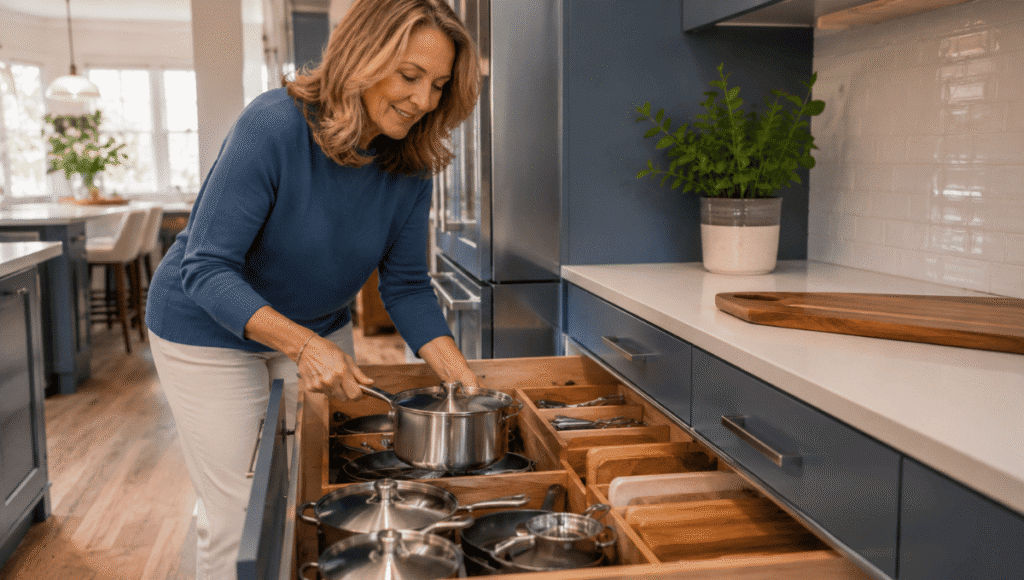
15. Reorganize Based on Your Real Routine
There is no single perfect kitchen organization system. The best arrangement is the one that works for your daily routine, your kitchen layout, and the way you use your body.
If you cook every day, your cooking tools deserve prime storage space. If you mostly prepare simple meals, you may not need an entire cabinet dedicated to specialized cookware.
If you rarely bake, baking supplies can occupy less convenient storage. Your kitchen should reflect what you actually do—not what you think a perfectly organized kitchen is supposed to look like.
Read also: How to Make Your Home Safer After 50
A Simple Kitchen Organization Reset
If your kitchen feels difficult to use, you do not need to tackle everything at once. Try this simple five-step reset:
Step 1: Identify your five most-used kitchen items.
Choose the things you reach for almost every day.
Step 2: Find where they are stored.
Notice whether you have to bend, stretch, twist, or reach deeply to retrieve them.
Step 3: Move them to easier locations.
Prioritize comfortable access over traditional storage habits.
Step 4: Relocate rarely used items.
Move occasional-use objects into less convenient storage areas.
Step 5: Test the new arrangement.
Use the kitchen normally for several days and see whether the new setup actually makes your routine easier. This approach is much more practical than trying to reorganize every cabinet at once.
When Kitchen Organization Is Not Enough
Changing your kitchen setup can make everyday tasks more convenient, but it should not be viewed as a treatment for ongoing or severe back pain.
If back pain is persistent, worsening, follows an injury, or interferes with normal daily activities, it is important to talk with a qualified healthcare professional.
You should also avoid forcing yourself to lift or move heavy kitchen equipment simply because you are reorganizing.
Ask someone for help with heavy objects when necessary. The goal of kitchen organization is to make everyday activities easier, not to push through pain.
Final Thoughts
A back-friendly kitchen starts with a simple idea: the things you use most should be the easiest things to reach.
Moving everyday cookware out of low cabinets, reducing deep bending, organizing refrigerator shelves, keeping countertops clear, and creating convenient kitchen zones can make everyday routines more manageable.
You do not need an expensive kitchen renovation to begin. Start with one cabinet, one drawer, or one daily task.
Look at how you move through the kitchen, identify the movements that feel unnecessarily awkward, and reorganize your space around your real routine.
A few thoughtful changes can turn a frustrating kitchen setup into one that feels more accessible, efficient, and comfortable for everyday life.
And after 50, that kind of practical organization can be just as valuable as having a beautiful kitchen.

Lauren is the founder of PainFreeAfter50.com and a dedicated researcher in joint health and healthy aging. After developing chronic joint pain in her early 50s, she spent years reviewing clinical studies and testing natural approaches to find real solutions. Today she shares honest, evidence-based guidance to help adults over 50 manage pain, improve mobility, and reclaim their quality of life.


1 thought on “Kitchen Organization Tips to Reduce Back Strain”